The Fermart Lab
Institute for Bioengineering of Catalonia / ICREA
Control of Process Settings for Large-Scale Additive Manufacturing With Sustainable Natural Composites
Abstract: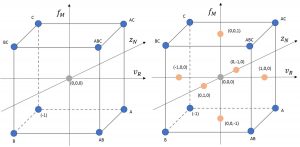
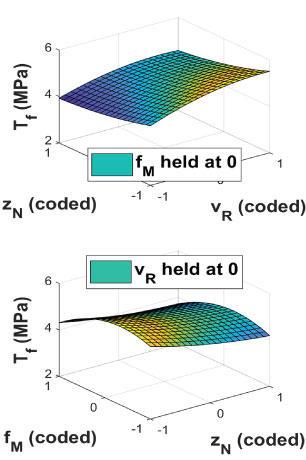
We present a system for 3D printing large-scale objects us-ing natural bio-composite materials which comprises of a preci-sion extruder mounted on an industrial six-axis robot. This paper highlights work on controlling process settings to print filaments of desired dimensions while constraining the operating point to a region of maximum tensile strength and minimum shrinkage. Response surface models relating the process settings to geomet-ric and physical properties of extruded filaments, are obtained through Face-Centered Central Composite Designed experi-ments. Unlike traditional applications of this technique which identify a fixed operating point, the models are used to uncover dimensions of filaments obtainable within operating boundaries of our system. Process setting predictions are then made through multi-objective optimization of the models. An interesting out-come of this study is the ability to produce filaments of different shrinkage and tensile strength properties, by solely changing pro-cess settings. As a follow up, we identify optimal lateral overlap and inter-layer spacing parameters to define toolpaths to print structures. If unoptimized, the material’s anisotropic shrinkage and non-linear compression characteristics cause severe delami-nation, cross-sectional tapering and warpage. Lastly, we show the linear scalability of the shrinkage model in 3D space which allows for suitable toolpath compensation to improve dimen-sional accuracy of printed artefacts. We believe this first ever study on the parametrization of large-scale additive manufacture technique with bio-composites will serve as reference for future sustainable developments in manufacturing.
Leave a Reply