The Fermart Lab
Institute for Bioengineering of Catalonia / ICREA
Artificial reproduction of chitinous mechanical versatility through metal doping and its use in resource-efficient product design
Abstract:
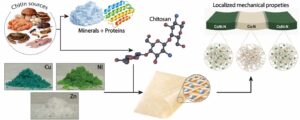
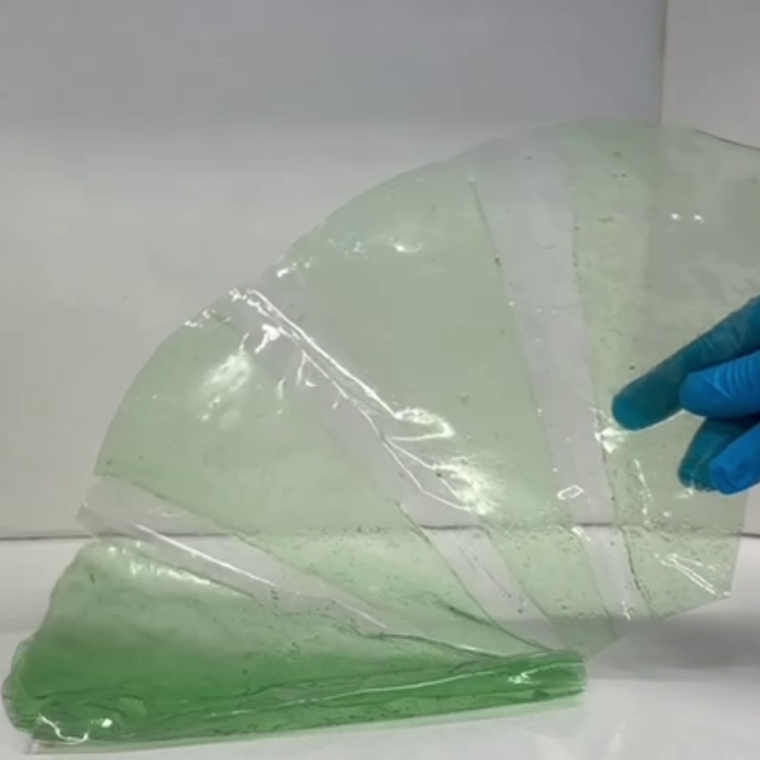
Structural biomaterials achieve diverse mechanical functions by reconfiguring a small chemical palette, often via metal–ligand coordination in hydrated matrices. Despite biology’s extensive use of such coordination in water-rich environments, engineered polysaccharide systems have primarily focused on mitigating moisture sensitivity rather than using hydration as a mechanical control parameter. In this article, we show that chitosan can be mechanically programmed by introducing divalent transition-metal ions (Cu, Zn, and Ni) and activating amines as inner-sphere donors through a simple post-casting neutralization. Multiscale characterization reveals metal-specific coordination states and water partitioning. These molecular differences produce distinct macroscopic behaviours: Zn increases dry strength and stiffness, Cu yields a more compliant and ductile response, and Ni inverts the hydration response, with immersion increasing modulus and strength. Because a single renewable backbone can span a wide mechanical range with minimal compositional changes, the approach reduces materials complexity in both manufacturing and end-of-life processing. Using only these minimal modifications, we fabricate a mechanically graded origami structure that integrates soft and stiff regions, demonstrating that coordination-mediated hydration control provides a scalable route to diverse mechanical designs from a single renewable biopolymer.